
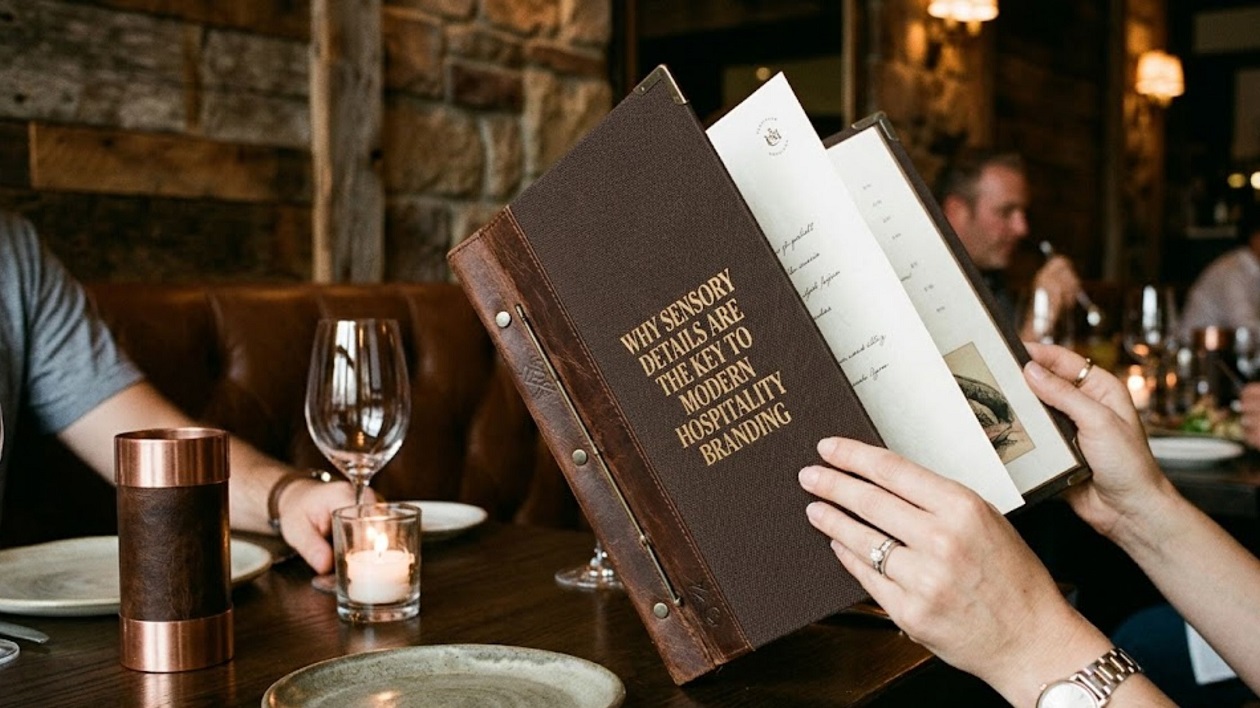
When a customer arrives, sits down, and looks at the menu for the first time, they already have a certain impression of you, although they have not even read a word yet. The heaviness of the cover, how the menu feels in their hands, and the way it opens, these are the first physical interactions your customer has with your restaurant. If this does not meet their expectations, it is hard to win them back, no matter how atmospheric your lighting is or how well you arrange the food on the plate.
This is what sensory branding is all about. It is not about how your restaurant looks, but rather it is a strategy to influence the perception of quality that your customers have before they taste the food.
When the Room and the Table Tell Different Stories
Hospitality businesses invest a lot of money in visual design, stone floors, reclaimed timber, bespoke joinery, carefully selected upholstery. Each choice of material sends a message. Then, the guest sits down and picks up a laminated A4 in a plastic sleeve. That’s the tactile gap. It’s when the seamless story your environment is telling hits a physical object that is from a different universe and a different business. Brand cohesion is not just visual. It’s textural. When the materials on your walls and the materials in your guests’ hands don’t speak the same language, the experience fractures in ways that most guests cannot name, but definitely feel. It’s an easy fix, for what it costs.
Matching Materials to Architecture
The best tabletop design takes inspiration from the room itself. If the bar front is copper, a copper-edged menu cover isn’t a gimmick, it’s a continuation. If the dominant material is dark buckram or aged leather, those same textures on the table make it feel like a seamless transition from the walls to the guest’s hands.
This is why sourcing decisions are important. Those looking for menus that would complement your space will realize that the materials talk starts with your room, not a catalog. Wood, fabric, leather, metal detailing, each of these comes with a set of associations. Rough-sawn wood reads as artisan and casual. Smooth leather reads as refined. Heavy woven fabric sits somewhere between warmth and luxury. None of these is the right answer in the abstract; they’re only right in context.
The end goal is that a guest should be able to close their eyes, hold the menu, and have that sensation be consistent with everything else they’re experiencing.
Why Weight Changes What People Think They’re Eating
Research backs up what those who work in the hospitality industry have known for a long time. According to a study published in the Journal of Consumer Psychology, people who are holding heavier objects tend to rate job candidates as more serious and competent, a perception that psychologists call “embodied cognition,” or the idea that the weight we feel in our hand can unconsciously transform our perceptions and attitudes. The “feeling” of weight leaks into a person’s social judgement.
The same bias is present in every restaurant dining room. Before you have even read about the steak the guest is considering buying, its quality has been partially determined by the sensation of holding the menu. It has weight. It is substantial. It has texture and resistance.
Color, Typography, and What They Signal Before the Food Arrives
Color psychology in menus is often simplified into “red is an appetizer.” It’s true, but the effect goes much deeper than that. Dark cranberry feels traditional and upscale. Subdued mint gives a sense of health and relaxation. High-intensity black and white feels bold and current. These connotations come into play with customers who don’t even realize they’re picking up on them.
Fonts play a part in this too. Narrow, angular type tells customers to get ready to energize. Wide, smooth lettering says this isn’t going to be too taxing. The merging of color and typeface on a menu cover is essentially the voice of your company in print form but without the need for words. When these components are selected intentionally, and used throughout all printed material, they communicate a consistency that’s tough to accomplish through designing alone.
The Shareable Table
Another element that has altered the equation. Customers take photos of their tables. The menu, the glassware, the plate, the entire table setting, it all ends up online, with tags, and shared. Menu covers that are visually unique appearing in the background of a guest’s photo are organic marketing that no paid ad can easily substitute since it’s trusted and in the right context.
In a world that’s digital-first, the objects with the most intentionally outstanding design have the broadest reach.
The hospitality industry has always known about ambiance. What’s changed is that we now know more precisely why it’s effective, and how to replicate it consistently. The menu that your guest is handed isn’t an object meant to be practical, merely holding a list of dishes. It’s the first object that they hold, and the first object that will let them know if the rest of the evening will be memorable.