

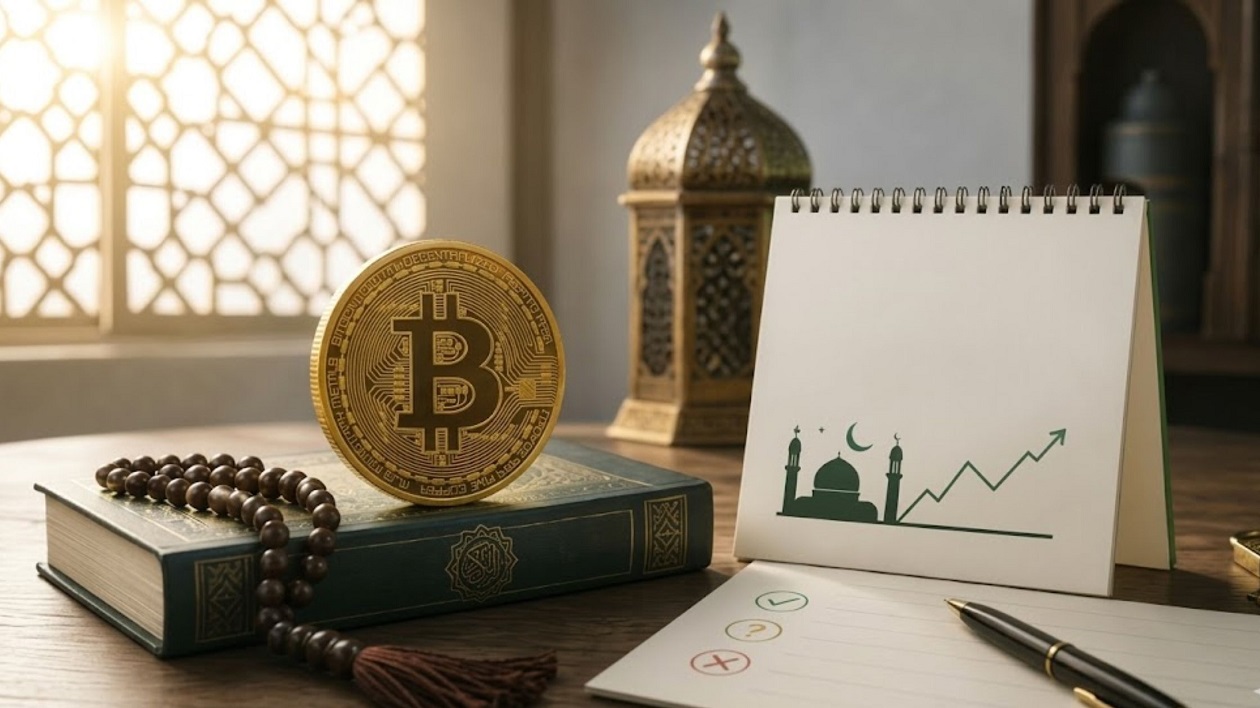
Cryptocurrency has made its way into daily conversations — and for observant Muslims, that raises a question that goes beyond market trends: does owning or trading Bitcoin cross a religious line?
Scholars from Cairo to Kuala Lumpur have studied this, and their answers don’t all point the same direction.
Understanding why they disagree — and what that means for your own financial decisions — is far more useful than looking for a simple yes or no.
The Three Pillars of Islamic Finance Every Crypto Investor Should Understand
Islamic finance isn’t a single rule — it’s a framework built around three core prohibitions that apply to every financial product, including digital assets.
Riba forbids any guaranteed, risk-free return earned simply by lending money — what most people recognize as interest.
Gharar targets ambiguity and excessive uncertainty in contracts; a deal where the outcome is wildly unpredictable, or where key terms are hidden, can be ruled invalid.
Maysir prohibits gains that come primarily from chance rather than productive effort — the clearest example being gambling.
Every fatwa on Bitcoin runs these three tests, and the disagreements mostly come down to how different scholars weigh each one against Bitcoin’s real-world behavior.
If you’re curious what the current market is telling us about Bitcoin’s adoption, checking the live is Bitcoin haram debate alongside BTC price data can give useful context for understanding how volatility plays into the gharar discussion.
Fatwas Against Bitcoin: What the Critics Actually Argue
The case against Bitcoin in Islamic law isn’t primarily about technology — it’s about behavior.
Egypt’s Grand Mufti issued an early and influential ruling declaring Bitcoin impermissible, grounding his decision in three specific observations: price swings severe enough to cause ordinary investors serious financial harm, complete disconnection from any recognized economic institution or productive asset, and a track record of use in illicit transactions that Islamic ethics would consider tainted earnings.
The Turkish religious directorate arrived at a similar verdict, focusing on gharar — arguing that a currency which can shed a third of its value within days creates the kind of extreme uncertainty that Islamic contract law cannot endorse.
Indonesia’s leading clerical body added maysir to the charge sheet, specifically targeting short-term speculative trading patterns that resemble betting on price movements rather than genuine commerce.
A separate and more philosophical objection came from British-based scholar Shaykh Haitham al-Haddad, who argued that no productive process backs Bitcoin’s value — it isn’t grown, manufactured, or tied to human labor in a conventional sense — which makes the act of mining new coins ethically equivalent to conjuring wealth from nothing.
The Halal Case: How Scholars Reached a Different Verdict
Malaysia’s national Shariah Advisory Council made headlines in 2020 by approving Bitcoin and other major cryptocurrencies as tradeable commodities — a classification that sidesteps many of the objections above.
The council’s chairman offered a deliberately practical analogy: digital currencies function much like store loyalty programs or airline miles — abstract units of value that communities agree to accept, store, and exchange.
Calling them inherently speculative, he suggested, misunderstands how new forms of value have always emerged throughout commercial history.
Mufti Muhammad Abu-Bakar approached the question through classical jurisprudence, evaluating Bitcoin against the traditional Islamic definition of mal — lawful property.
His conclusion was that Bitcoin qualifies: it is desired by real people, it can be reliably stored, and it is recognized as having legal value across multiple jurisdictions.
The presence of investment risk, he emphasized, does not by itself make something haram — equities and real estate carry risk too, and no serious scholar forbids them outright.
Another important voice came from the Shariah committee of a major Islamic bank, arguing that the requirement for currencies to have metallic backing — gold or silver — was a historical convention, not a divine mandate.
Under this reading, widespread social acceptance and genuine utility are what grant an asset legitimacy, and Bitcoin’s expanding use by merchants, fintech platforms, and institutional investors steadily strengthens that argument over time.

Spot Trading vs. Derivatives: Where the Real Line Gets Drawn
Even scholars who permit Bitcoin tend to draw a hard boundary between two very different types of transactions.
Spot trading — paying full market value immediately and taking direct ownership of the asset in the same moment — passes most Shariah tests because the exchange is transparent, settled in real time, and involves no borrowed money.
Derivatives are a completely different story.
Futures contracts, perpetual swaps, options, and margin positions each introduce at least one of the three prohibited elements: margin trading brings riba through interest on borrowed funds; futures contracts create gharar through deferred settlement at uncertain future prices; leveraged speculation mimics the structure of gambling closely enough that most scholars classify it as maysir.
The platform matters too — an exchange that pays “yield” on idle crypto balances through lending desks, or charges overnight fees on open positions, adds interest-like layers that can compromise an otherwise clean trading setup.
A Practical Checklist for Faith-Conscious Crypto Investors
Getting this right doesn’t require a law degree — it requires discipline around a handful of specific choices.
- Transact only through spot markets where payment and delivery happen simultaneously
- Never open margin accounts or use leverage of any amount
- Avoid all derivative products: options, futures, synthetic tokens, and perpetual contracts
- Select platforms that do not pay or charge interest on account balances
- Verify that any token you buy is not connected to industries Islam prohibits — gambling, alcohol, or adult content
- Treat highly speculative assets with minimal real-world adoption as presumptively risky under the maysir standard
- Seek a ruling from a qualified scholar who has genuine familiarity with how digital asset markets actually function
Conclusion
Bitcoin’s permissibility under Islamic law is genuinely contested — not because scholars are confused, but because the asset itself sits at the edge of categories that classical jurisprudence was never designed to address.
Where most thoughtful authorities seem to converge is around method: a straightforward spot purchase, held for legitimate purposes, on a platform free from interest-based mechanisms, clears the bar for most Shariah frameworks.
Speculative instruments — leverage, derivatives, margin accounts — fall outside that boundary by nearly every scholarly measure.Let the three core prohibitions guide your thinking, get advice from a scholar you trust, and remember that how you participate in any market is often more religiously significant than what you invest in.