


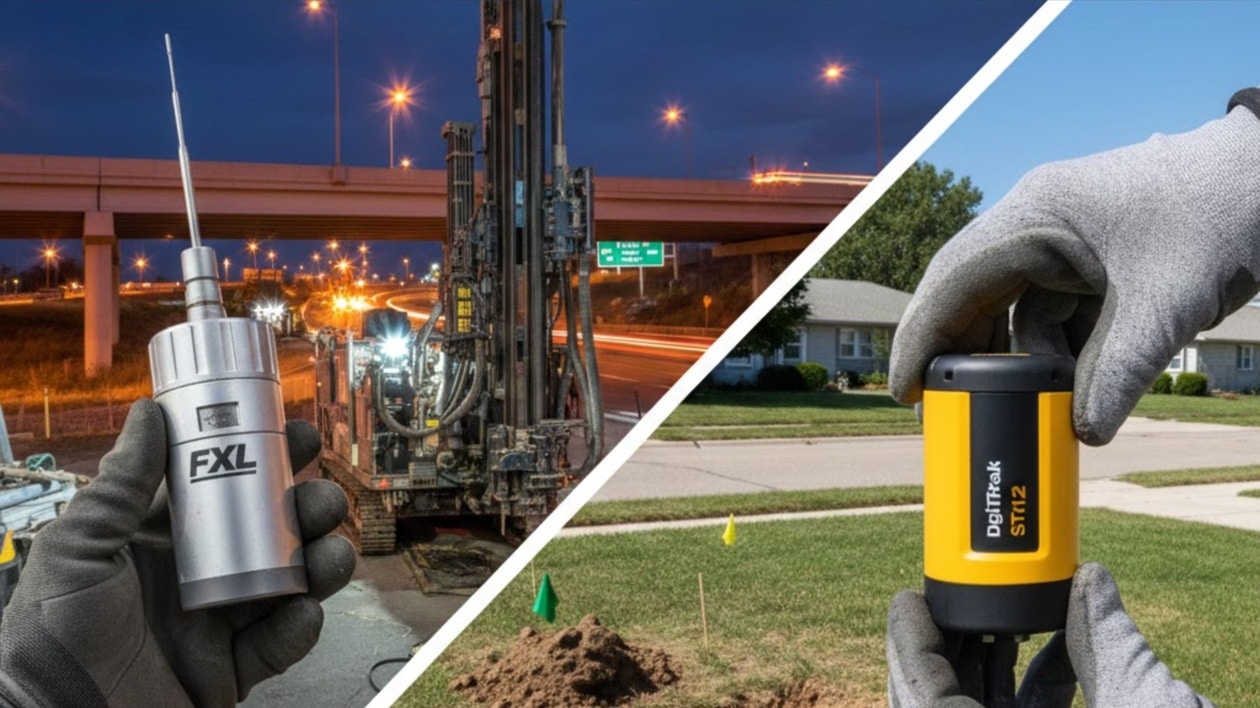
If you run horizontal directional drilling crews long enough, you learn that not all bores are created equal. Some are short, shallow, and straightforward. Others are deep, stretched under highways or rivers, and pushed through noisy, rebar-heavy city streets.
Using the same beacon strategy for both types of work is like using the same drill bit for clay and solid rock. It can be done, but you will waste time and money along the way. That is why smart contractors gradually move to a layered transmitter setup, with long-range sondes for the most demanding pilots and standard, compact sondes for everyday utility work.
In this guest post, we will look at how to think about that mix, how long-range units like FXL series transmitters fit in, where compact models such as the DigiTrak ST 12 transmitter shine, and how to put all of it into one simple, practical plan.
Two different jobs, two different transmitter roles
On paper, many sondes can look similar. They all list a depth rating, a frequency and some run time numbers. In the ground their behavior can be very different. The easiest way to see this is to separate your work into two broad groups.
- Everyday utility bores
- Service lines into homes and shops
- Short road and driveway crossings
- Local utility relocations at modest depth
Here, you mainly need dependable depth and pitch, not extreme range.
- High consequence or high difficulty bores
- Crossings under highways, rivers, or rail lines
- Deep shots in rocky or highly variable ground
- City center work near power, loops, and lots of steel
Here, you care a lot more about staying in touch with the head at long distances and through heavy interference.
It should not surprise anyone that the same beacon cannot be perfect for both groups. Long-range sondes trade size and battery life for reach and punch. Standard sondes trade ultimate reach for compact size and simplicity. Both are essential if you want guidance to feel controlled instead of chaotic.
Where long-range FXL transmitters earn their keep
When you look at the tough end of your project list, you are usually talking about deeper pilots, longer flights of rods and more unpredictable interference. That is where high-performance long-range sondes come into their own.
Units in the FXL family are a good example. These are designed to give you:
- Stronger, more stable signal deeper in the ground
- Better behavior in difficult soil mixes and higher background noise
- Enough data range that the locator can stand in a safe, comfortable position and still see the head clearly
They cost more than basic sondes, and they are overkill for many short jobs, but when you hit those big, high-risk projects, the extra capability pays for itself. For many fleets, it makes sense to treat this type of beacon as a dedicated kit for your flagship rig and critical crossings.
If you are weighing up options and want to dive into specifications and use cases, you can always read more about the different long-range models before you decide how many to keep in your inventory. When the bore is deep, long, or both, that extra planning shows up as fewer lost signals and fewer emergency pull-backs.
On the purchasing side, contractors often standardize on a particular long-range model; for example, they might build their hardest jobs around a trusted set of transmitters fxl19 so that housings, batteries, and crew expectations all match the same behavior.
Why you still need compact standard DigiTrak transmitters
Not every job deserves a premium long-range beacon. In fact, if you try to run your whole schedule on high-end sondes, you will probably overspend on hardware and undersupply your crews.
For everyday work, a tough, compact transmitter such as a Digitrak ST 12 transmitter can be a perfect fit. It is small enough to fit into compact housings, which matters when you are working with shorter heads and tighter bends. It delivers plenty of depth and data range for service and distribution work, and it is simple enough that crews quickly learn how the signal behaves in local soils.
This is exactly the type of beacon you want on your “bread and butter” rigs. They leave the yard almost every day, handle the bulk of your revenue-generating bores, and rarely need extreme performance. What they do need is predictability. One main standard sonde model, plus an identical spare on the truck, often does more for production than an overpowered beacon that is not really built for those jobs.
Building one transmitter pool instead of many random piles
Things start to fall apart when every rig hoards its own random set of sondes. Over time you end up with boxes full of mixed models, mixed ages, and mixed conditions. Nobody quite knows which beacon is suited to which job.
The cure is to treat all transmitters as one shared pool with clear labels and roles. For example:
- Long-range segment
- FXL-type sondes assigned to deep and high-consequence projects
- Used primarily with your most capable rig and most experienced locator
- Standard segment
- Compact sondes like DigiTrak ST series units are assigned to everyday utility rigs
- Kept in sufficient numbers that every rig has at least one primary and one spare
- Training and retirement segment
- Very old or slightly quirky sondes used only for short test bores or yard training
Once you have that structure, it becomes easy to answer questions like “which beacons are safe to take under this highway” or “which ones should we save for deep city jobs.”
Daily habits that protect both long-range and standard sondes
Whether you are running premium FXL beacons or everyday ST series sondes, the way crews handle them day to day determines how long they last. Some high-value habits:
- Wipe grit off threads and sealing faces before opening or closing housings
- Replace any o-ring that looks flattened, nicked, or shiny instead of waiting
- Keep battery compartments dry and corrosion-free, and avoid mixing old and new cells
- Store sondes in padded cases, not loose in metal toolboxes
- Pull and tag any beacon that begins to show jumpy or inaccurate readings, then bench test it before sending it back out
These small routines often double the useful life of both your long-range and your standard transmitters, which is the difference between a stable guidance plan and constant last-minute purchases.
Putting it all together
You do not need a yard full of exotic equipment to fix “signal problems.” You need a clear idea of which bores demand long-range performance and which are better served by compact, robust standard sondes.
Define the roles. Build a small, strong group of long-range transmitters for your toughest work. Pair them with a reliable, standardized family of compact DigiTrak transmitters for everyday rigs. Manage everything as one shared, labeled pool and back it up with a handful of simple field habits.
Do that, and the guidance side of your HDD business stops feeling like a gamble. Your crews can focus on drilling good holes while the sondes quietly do what they were designed to do, job after job.