


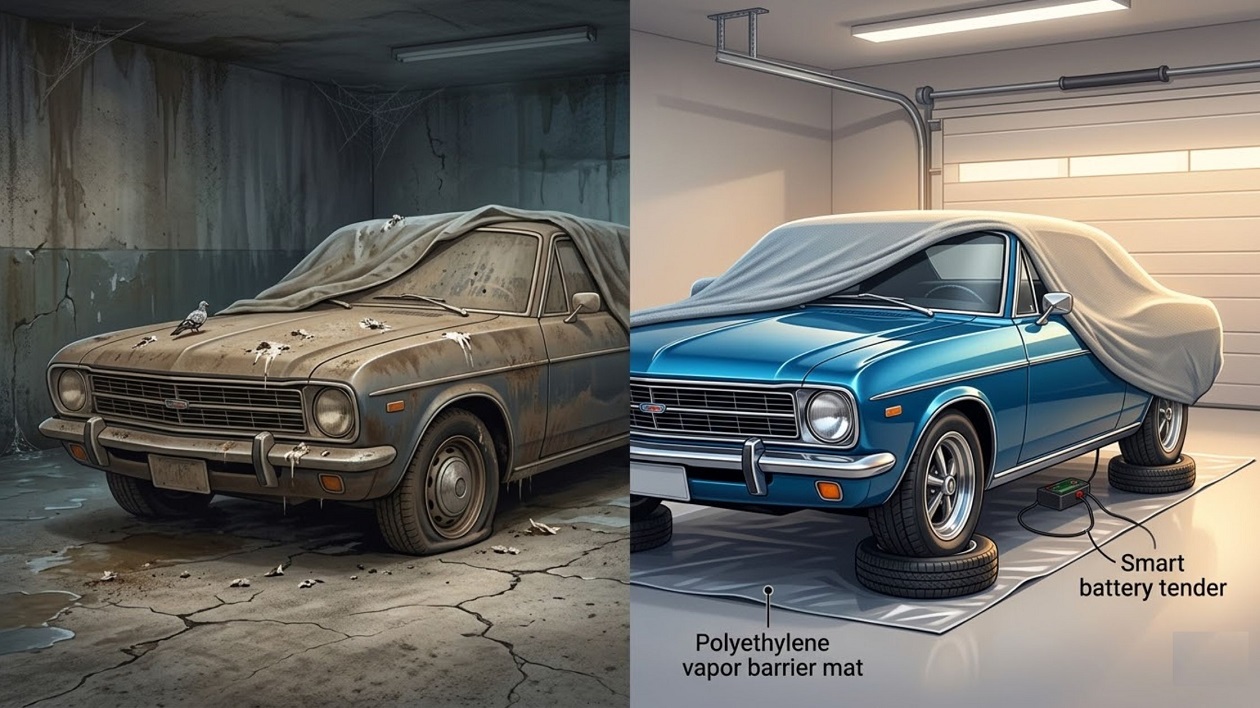
When your car isn’t being used, its components are no less susceptible to wear and tear. In fact, many parts of your car are in a far more vulnerable state when your car is immobile for a longer period of time.
The Real Cost Of Surface Neglect
Damage to the paint coat is the easiest way for a buyer to justify their lowball offer, and most of it occurs long before you put that vehicle on the market.
UV radiation oxidizes the clear coat – the topmost protective layer of paint – in a process that starts to build up in your first year and accelerates each year after. What starts as a minor dulling becomes peeling, fading, and hazing that even a professional detail job can’t fully undo. But bird excrement and tree sap are even worse. Both are acidic and, when combined with heat, can etch into the clear coat in as little as 48 hours, reaching three-millimeters deep. Once that acid etching occurs, the damage is structural, not just superficial.
The answer seems as easy as just covering your car. But all covers are not created equal. Generic plastic covers lead to moisture being trapped against the increasingly warm paint coat. As day turns to night and the temperature of the paint rises and falls with the air, the resulting humidity-mixed-with-heat can cause micro blistering beneath the cover. Classic Additions Car Covers are designed to be both breathable and tailored to specific vehicle profiles, which eliminates the friction and moisture buildup that off-the-shelf covers produce.
Interior Preservation Matters As Much As The Exterior
A vehicle may appear clean and well-maintained on the outside, but a musty or moldy smell inside is a deal-breaker for many potential buyers.
It all comes down to the decay of organic material – spilled coffee, cookie crumbs, or the inevitable pet hair – over time. In a warm environment, that breakdown speeds up. A faint odor seeps into foam seats and the backing of the carpet. After that, substitute cleaners will never get it out, and you’re looking at an expensive professional cleaning that may not even work. Before you park the car and let it fester, get your shop-vac and use it on EVERYTHING, and don’t forget to give your leather a good rub with conditioner: this will prevent cracking and help keep smells from setting in.
Climate control is the best solution yet. If you have one, use it. Leather and rubber both suffer more down the road if they’re subjected to baking hot then freezing cold environments.
Mechanical Inactivity Has a Price Tag Too
Many owners think of mechanical condition in terms of service intervals. Fewer think about what inactivity does to a car.
Seals and gaskets need the fluids they hold to maintain their elasticity. Long periods of inactivity dry them out, and before you know it, you have slow leaks that you don’t notice before they become expensive. Brake fluid is hygroscopic, meaning it pulls moisture from the air, degrading its performance and adding to the internal corrosion in the brake lines.
For any vehicle stored over 30 days, how you start it up again counts. Don’t just turn-key and go; let the engine get to temperature, check fluids before you drive off, possibly take a short drive so fluids can work through the systems. A fuel stabilizer also ensures ethanol blended fuels don’t break down and clog your injectors due to inactivity.
Protecting What’s Underneath and What’s Touching The Ground
There are two neglect-prone areas every owner should know about: the floor, and the tires.
Concrete floors tend to release moisture vapor. And if there’s no vapor barrier installed between that floor and the vehicle’s undercarriage, that moisture can slowly corrode its way into your car’s exposed metal components. While your unsuspecting components and frames get eaten away at what feels like a snail’s pace, a simple polyethylene sheet takes care of protection way cheaper than we’d all care to think.
If your vehicle sits in one place for an excessive span of time, its tires will develop flat-spots. That’s the rubber at the contact point taking on permanent deformation, and in severe cases, that’ll create a vibration that never truly smoothens out once the vehicle is in motion again. To prevent that, you’ve either got tire cushions that distribute the load over a larger surface or slightly higher tire pressure that helps to maintain the structural integrity of a tire that’s been pegged in position (by a fraction of an inch on one spot) for months. A set of tire cushions or a few extra PSI towards the sky costs almost nothing relative to a fresh set of tires.
Finally, if you’re dealing with a battery, the smart money isn’t on a smart charger, but on a battery tender. An extra 20 bucks keeps the battery optimally charged and doesn’t bias against a fragile battery one bit in the process of frequent deep discharge cycles.
What a Higher Asking Price Actually Looks Like
If you trade in a well-maintained car that also has documented cosmetic upkeep, it can be worth around 15% to 20% of the purchase price more than the same make and model in fair condition. On a $25,000 vehicle, that’s $3,750 to $5,000 – well above the total cost of covers, stabilizers, and a battery tender.
We’re not asking you to do anything unusual to increase your vehicle’s resale value – just not to do the intuitive thing. For most people, storage is a wash, a time when nothing happens. In fact, it’s a little-noticed subtraction of dollars and cents from your asset. Give your car the storage it deserves, you won’t regret it.