


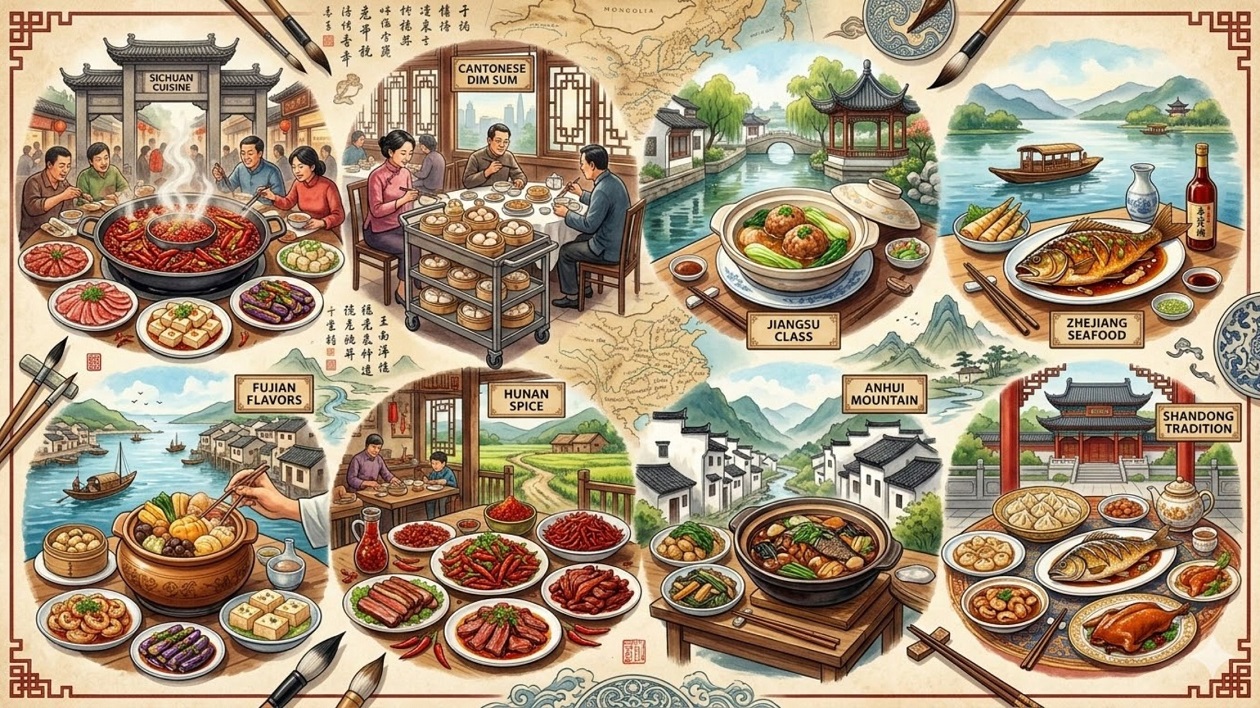
In most parts of the world, “Chinese food” is treated as a single culinary category, but this framing is not simply an oversimplification. It really is a category error. China is a country of 1.4 billion people spread across a territory roughly the size of Europe, encompassing dramatically different climates, geographies, agricultural systems, and ethnic populations. The eight regional cuisines formally recognized within China — known collectively as the Eight Great Cuisines or Ba Da Cai Xi — represent distinct culinary traditions with different flavor profiles. If you learn Mandarin online or with an online Chinese teacher, you may have been told at the one or the other instance just how, for example, not all Chinese people like spicy food! There is a big differnece between the North and South, too.
Sichuan Cuisine (川菜, Chuān Cài)
Sichuan cuisine is currently the most internationally visible of the eight, driven by the global spread of hot pot restaurants and growing awareness of the mala flavor profile — a combination of heat from dried chilies and the distinctive numbing sensation produced by Sichuan peppercorns. The peppercorn, which contains a compound called hydroxy-alpha-sanshool, produces a tingling paralysis of the lips and tongue that is unlike any other spice sensation and that is central to Sichuan cooking’s identity. The cuisine is not, however, reducible to spice. Sichuan cooking encompasses a documented 24 distinct flavor profiles, of which mala is only one. Fish-fragrant sauce (yuxiang), despite containing no fish, combines pickled chili, garlic, ginger, and vinegar into a sharp, complex condiment used with pork, eggplant, and tofu. Strange-flavor sauce (guaiwei) layers sweet, sour, spicy, numbing, salty, and savory simultaneously. The technical range of Sichuan cooking is considerable, and its practitioners have historically been among the most respected in China.
Cantonese Cuisine (粤菜, Yuè Cài)
Cantonese cuisine, originating in Guangdong province and the Pearl River Delta, is the style most familiar to international audiences, largely because the majority of early Chinese emigrants to Europe, North America, and Australia came from Guangdong and brought their food culture with them. What most Western countries have understood as “Chinese food” for the past century has been, in reality, a heavily adapted version of Cantonese cooking. The authentic tradition is considerably more refined. Cantonese cuisine places a premium on freshness, quality of ingredients, and restraint in seasoning — the goal is to enhance the natural flavor of a ingredient rather than transform it. Steaming and stir-frying at very high heat are the dominant techniques. Seafood, which is typically kept alive until the moment of cooking, is treated with particular care. Dim sum — the tradition of small dishes served alongside tea, consumed in the morning or at midday — is a Cantonese institution with its own extensive repertoire of dishes and its own social rituals.
Jiangsu Cuisine (苏菜, Sū Cài)
Jiangsu cuisine, sometimes called Su cuisine, originates in the prosperous lower Yangtze River delta region and is historically associated with the refined tastes of the imperial court and the scholar-official class. The city of Suzhou, in particular, has a long reputation for delicate, sweet-leaning food that reflects centuries of wealth and aesthetic cultivation.
The cuisine is characterized by precise knife work, careful attention to the visual presentation of dishes, and a preference for light, slightly sweet flavors produced through careful braising and slow cooking. Dishes are often constructed to resemble other objects — food shaped like flowers, animals, or landscapes is a recurring feature of formal Jiangsu cooking. The Lion’s Head meatball, a large pork meatball braised slowly in a clay pot until the fat has rendered and the meat is tender enough to cut with chopsticks, is one of the cuisine’s most celebrated preparations.
Zhejiang Cuisine (浙菜, Zhè Cài)
Now, Zhejiang cuisine shares some characteristics with Jiangsu cooking — both belong to the broader culinary culture of the Yangtze delta — but has a distinct identity rooted in the province’s coastal geography and its freshwater lake and river systems. West Lake in Hangzhou, the provincial capital, has given its name to several canonical dishes, including West Lake Vinegar Fish, a whole freshwater fish cooked in a sweet-and-sour sauce with a precise balance of acidity that is considered a benchmark preparation. The cuisine makes extensive use of bamboo shoots, freshwater crab, river shrimp, and preserved vegetables. Shaoxing, a city in northern Zhejiang, produces the rice wine that bears its name and that is used as a cooking ingredient throughout Chinese cuisine — but which is most carefully and extensively deployed in the food of its home province. Zhejiang cooking tends toward freshness and lightness, with an emphasis on seasonal ingredients used at their peak.
Fujian Cuisine (闽菜, Mǐn Cài)
Fujian cuisine, from China’s southeastern coastal province, is among the least internationally known of the eight but occupies an important position in the broader history of Chinese food culture. Fujian was historically one of China’s primary points of maritime emigration, and Fujianese cooking has had a significant influence on the food cultures of Southeast Asia — particularly in Malaysia, Singapore, Indonesia, and the Philippines, where Fujianese communities established themselves over centuries of trade and migration. The cuisine is notable for its use of umami-rich broths and soups, its incorporation of fermented and preserved ingredients, and its relatively light seasoning compared to the spicier inland traditions. Red fermented tofu and red yeast rice are characteristic flavor components. Buddha Jumps Over the Wall — a complex, labor-intensive soup containing seafood, meat, and numerous premium ingredients slow-cooked in a sealed vessel — is the most famous single dish in the Fujian repertoire and one of the most technically demanding preparations in all of Chinese cuisine.
Hunan Cuisine (湘菜, Xiāng Cài)
Then there is Hunan cuisine, which is sometimes compared to Sichuan cooking because both traditions make extensive use of chili. The comparison is worth making precisely to establish the differences. Where Sichuan cooking pursues complexity through the layering of multiple flavor profiles — including the numbing effect of Sichuan peppercorn — Hunan cooking tends toward a more direct, unmediated heat. The province’s food is often described as xian la, or purely spicy, without the numbing component that defines mala. Hunan cooking also makes significant use of smoked and cured meats, particularly pork, and of pickled and fermented vegetables, which contribute an acidic sharpness to many dishes. Steaming and stir-frying are the dominant techniques. Chairman Mao, who was born in Hunan’s Shaoshan county, is said to have maintained a strong preference for Hunanese food throughout his life — a biographical detail that has become a marketing hook for numerous restaurants in the province, though the food needs no such endorsement to justify attention.
Anhui Cuisine (徽菜, Huī Cài)
Anhui cuisine is the least well-known of the eight both internationally and within China itself, and occupies something of an anomalous position within the canon. The cuisine originates in the mountainous southern portion of Anhui province, historically a region of limited agricultural land whose inhabitants were driven by economic necessity to become merchants — the Huizhou merchants who built the whitewashed courtyard villages now recognized as UNESCO heritage sites were also responsible for spreading Anhui food along their trade routes. The cuisine is characterized by its use of wild herbs, mountain vegetables, and preserved ingredients, and by a preference for braised preparations that develop deep, rich flavors over long cooking times. River fish and freshwater crustaceans feature prominently. Li Hongzhang Hotchpotch, a braised mixed dish of meat, tofu, and vegetables named after the Qing dynasty statesman, is one of its better-known preparations internationally, though the attribution is of uncertain historical accuracy.
Shandong Cuisine (鲁菜, Lǔ Cài)
Shandong cuisine holds a position of particular historical prestige within Chinese culinary tradition. It is the oldest of the eight formally recognized styles, with roots in the culinary culture of the state of Lu during the Spring and Autumn period — the same time and place that produced Confucius, whose philosophy of ritual propriety and social order extended to the preparation and consumption of food. Shandong was also the dominant culinary influence on the imperial court kitchens of Beijing for several centuries, meaning that what came to be understood as formal Chinese court cuisine was largely Shandong cooking adapted to the resources and expectations of the imperial household. The cuisine is built on a foundation of wheat-based staples — noodles, dumplings, and steamed breads — reflecting the province’s agricultural base, and makes extensive use of seafood from the Bohai and Yellow Seas. Its flavor profile tends toward savory and rich, with a preference for soy sauce, vinegar, and garlic as seasoning agents. Braising and deep-frying are prominent techniques. The cuisine lacks the international visibility of Cantonese or Sichuan cooking but represents, in terms of its historical depth and its influence on the broader development of Chinese culinary culture, the most foundational of the eight traditions.
Food vocabulary in Mandarin is extensive, culturally specific, and not easily navigated through translation alone. The names of dishes frequently reference historical figures, geographical features, poetic imagery, or cooking techniques in ways that a direct translation cannot convey. Understanding why a dish is called what it is called — and what that name implies about its origins, its ingredients, or its cultural significance — requires a level of linguistic and cultural familiarity that goes beyond functional Mandarin.
Some teaching institutions like GoEast Mandarin may have a curriculum which incorporates culture as actually a core component of language instruction, recognizing that language and culture cannot be separated without losing something essential from both. Students working through their programs develop the ability to read a menu and order a dish as well as the broader cultural literacy to understand what they are eating!