


For students planning to study, work, or migrate abroad, providing English language proficiency is often a mandatory step. Among the globally accepted English tests, the TOEFL test and IELTS are the two most commonly required by universities and immigration authorities. While both exams assess similar language skills, they differ in format, scoring, test environment, and acceptance preferences across countries and institutions.
Choosing between TOEFL and IELTS is not about which test is earlier but about which test aligns better with a student’s academic goals, test-taking style, and destination country. Many students make this decision without fully understanding these differences, leading to avoidable stress or suboptimal outcomes.
This article offers a clear, side-by-side comparison of the TOEFL exam and IELTS, helping students make an informed choice based on structure, scoring, cost, and practical suitability rather than assumption or trends.
Key Takeaways
- The TOEFL test and IELTS assess the same core English skills but differ in format and delivery.
- TOEFL is entirely computer-based, while IELTS offers both paper-based and computer-based options.
- University and country preferences influence which test is more suitable.
- The right choice depends on academic goals, comfort level, and application requirements.
Understanding the TOEFL Test
The TOEFL test (Test of English as a Foreign Language) is designed to assess academic English proficiency, particularly for students applying to universities where English is the primary language of instruction. It is widely accepted by universities in the United States, Canada, and several other countries. The TOEFL iBT evaluates four core skills:
- Reading
- Listening
- Speaking
- Writing
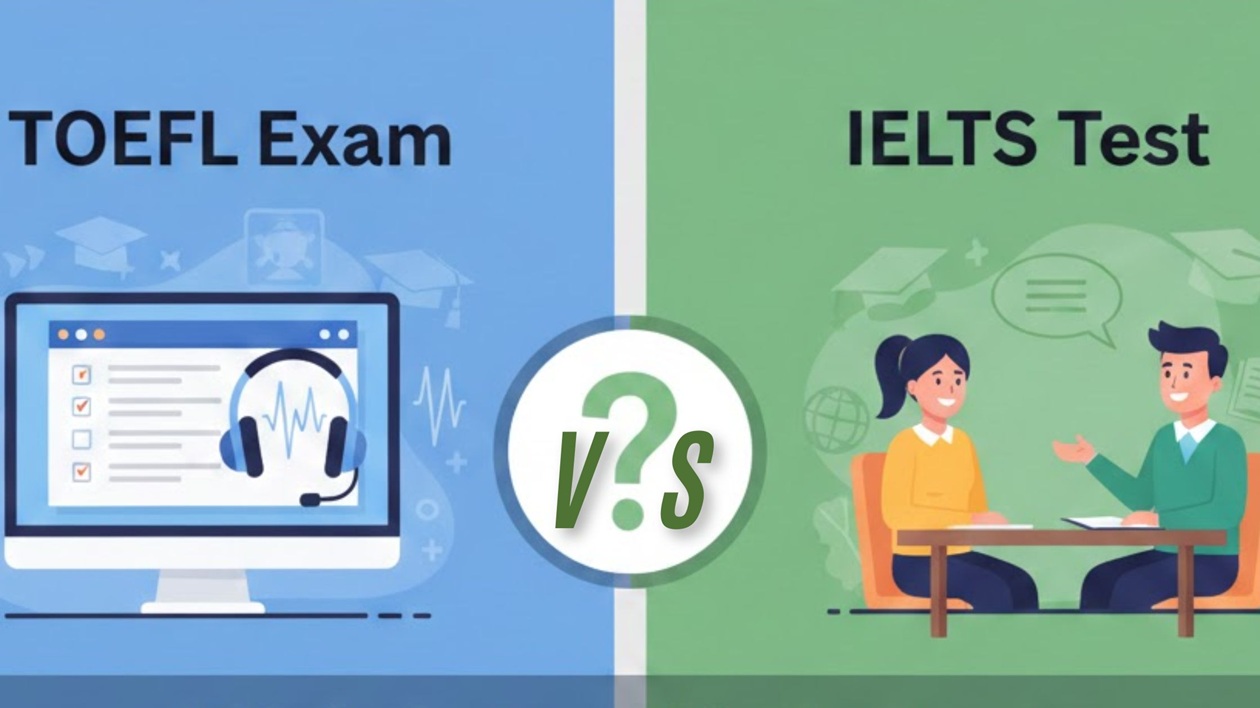
All sections are conducted on a computer, and the speaking section requires candidates to record responses using a headset. The test focuses heavily on academic contexts such as lectures, classroom discussions, and reading passages.
Understanding IELTS
IELTS (International English Language Testing System) is jointly managed by international education bodies and is accepted across the UK, Australia, Canada, and many European countries. It is available in two formats:
- IELTS General Training
- IELTS Academic
For students applying to universities, IELTS Academic is required. Unlike the TOEFL test, IELTS includes a face-to-face speaking test conducted by an examiner, which some candidates find more natural and interactive.
TOEFL vs IELTS: Key Format Differences
While both tests assess the same language skills, their formats differ significantly.
TOEFL Test Characteristics:
- Integrated questions combining reading, listening, and speaking
- Scores reported on a 0-120 scale
- Fully computer-based
- Automated speaking responses
IELTS Test Characteristics:
- A separate speaking interview with an examiner
- Paper-based or computer options
- Scores reported on a 0-9 band scale
- Broader mix of academic and general English usage
Students who are comfortable typing and speaking into a computer may prefer the TOEFL test, while those who perform better in direct conversations may find IELTS more suitable.
Acceptance and University Preference
Both exams are widely accepted, but preferences vary by country and institution.
- Canadian universities accept both tests equally
- US universities traditionally prefer the TOEFL test, though many also accept IELTS
- UK, Australian and New Zealand universities widely accept IELTS
- Some professional bodies or visa routes specify one test over the other
Students should always check specific university or program requirements rather than relying on general assumptions.
TOEFL Exam Fee in India and Cost Comparison
Cost is an important factor when planning test preparation.
- IELTS exam fees in India are generally around Rs. 16,250
- The TOEFL exam fee in India is approximately Rs. 16,900 (subject to change)
Additional costs may apply for rescheduling, score reporting beyond free limits, or retakes. While the fee difference is not significant, students should account for preparation expenses and potential retake costs when planning.
Scoring System Explained
The two tests use different scoring systems, which can be confusing.
TOEFL Test Scoring:
- Total score out of 120
- Each section scored from 0 to 30
- Universities set minimum cut-off scores based on program requirements
IELTS Test Scoring:
- Overall band score calculated as an average
- Each section scored from 0 to 9.
- Universities often specify a minimum band score for each section
Understanding score equivalency is important when shortlisting universities
Which Test Should You Choose?
There is no universal answer. The decision depends on individual factors such as:
- Availability of preparation resources
- Comfort with academic vs conversational English
- Target country and university requirements
- Preferred test format (computer vs. examiner-led)
Some students also seek structured guidance from educational platforms such as Leverage Edu to evaluate test suitability alongside university shortlisting and application planning. Such guidance supports informed decision-making but does not influence test results or admission outcomes.
Common Preparation Considerations
Regardless of the test chosen, effective preparation includes:
- Understanding the exam format thoroughly
- Practising timed mock tests
- Reviewing writing and speaking feedback critically
- Improving academic vocabulary and listening skills
Consistent practice and familiarity with test conditions often matter more than the choice between TOEFL and IELTS.
Choosing between the TOEFL test and IELTS is a strategic decision that should be based on individual strengths, academic goals, and institutional requirements rather than popularity alone. Both exams are globally recognised, well-structured and accepted by leading universities worldwide.
By understanding differences in format, scoring, acceptance, and costs, such as the TOEFL exam fee in India, students can make confident, well-informed choices. With realistic planning and focused preparation, either test can serve as a strong foundation for international academic opportunities.
FAQs
Q1: Is the TOEFL easier than the IELTS?
It depends on you; neither the TOEFL nor the IELTS are always simpler. If you are at ease using computers and speaking into a microphone, the TOEFL will be easier for you. If you like in-person interactions and more conventional exam formats, IELTS is simpler.
Q2: Which test is best, IELTS or TOEFL?
Universities in the United Kingdom, the United States, Canada, and Australia accept the IELTS or Test of English as a Foreign Language, which is a popular exam in American universities, making it the best choice if you are more at ease speaking American English and want to study there.
Q3: Is 7.5 a good score for IELTS?
An overall IELTS band score of 7.5 is regarded as a strong accomplishment. With this score, you can easily get international employment possibilities, direct entrance to prestigious colleges, and scholarships to study abroad.