

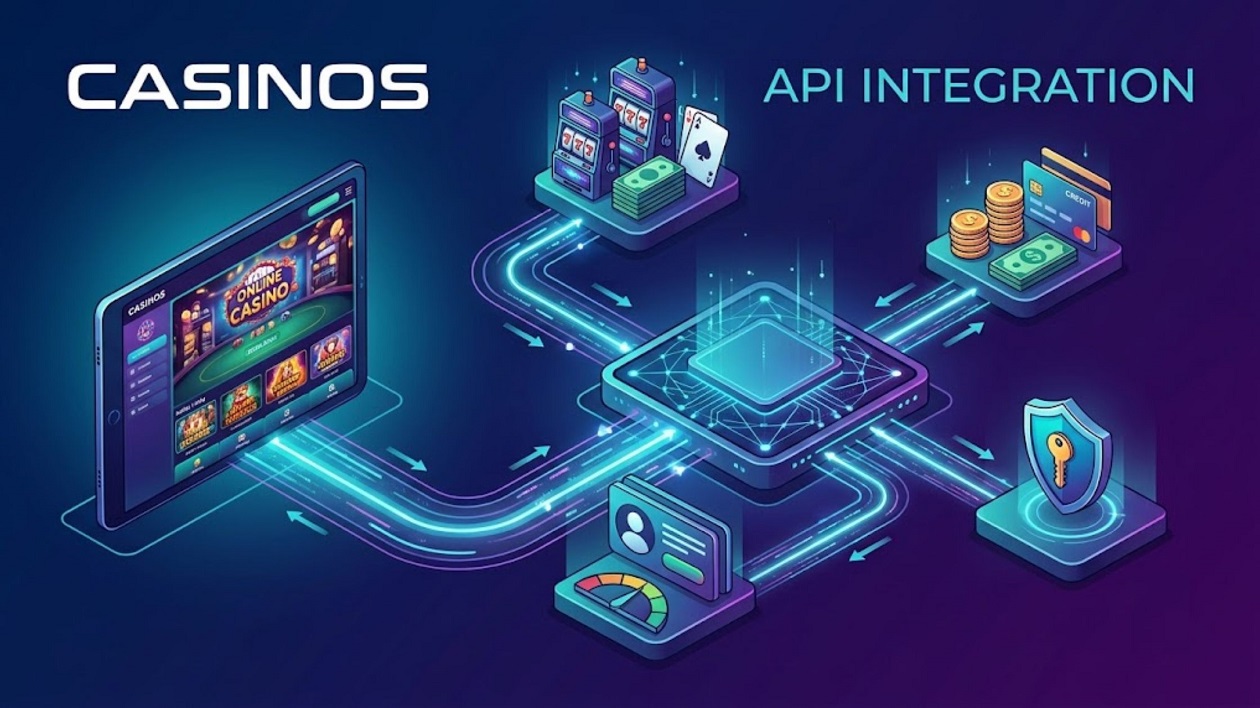
A player opens an online casino, chooses a game and clicks “Play.” Within seconds, the game loads, the correct account balance appears, the preferred currency is selected and every wager is recorded.
To the player, the experience feels simple. Behind the screen, however, several independent systems may be communicating in real time.
The casino platform needs to connect with the game provider, player account, payment infrastructure, bonus engine, reporting tools and security systems. An online casino games API makes these connections possible without requiring every service to be built into one enormous platform.
API integration has therefore moved from being a useful technical feature to becoming a central part of modern iGaming infrastructure.
What Is an Online Casino Games API?
API stands for Application Programming Interface. In practical terms, an API is a structured way for two software systems to exchange information and request actions from one another.
For an online casino, an API may allow the main platform to:
- request a list of available games;
- launch a selected game;
- identify an authorised player;
- retrieve or update a player’s balance;
- record bets and results;
- apply bonuses or promotional features;
- collect game-performance data;
- generate reports for operational or compliance purposes.
Rather than transferring information manually, these processes happen automatically through defined requests and responses.
For example, when a player launches a slot, the casino platform can send a request containing the player’s session details, currency and selected game. The provider then confirms the session and returns the information required to open the game.
The result is an experience that feels immediate, even though multiple systems are working together behind the scenes.
Why API Integration Has Become So Important
Online casinos are no longer simple websites with a small collection of games. A competitive platform may need to support hundreds or thousands of titles, multiple payment options, several languages, different currencies and customers using a wide range of devices.
Building every component internally would be expensive, slow and difficult to maintain.
API integration allows operators to use specialised technology from external providers while keeping the player experience within a single platform.
| Area | Without Effective API Integration | With Effective API Integration |
| Game launches | Separate systems and inconsistent loading | Games launch through a connected interface |
| Content updates | Titles may need to be added manually | New games can be added more efficiently |
| Player balances | Greater risk of delayed information | Balance data can be synchronised in real time |
| Reporting | Data may be stored in separate locations | Information can flow into central reporting tools |
| Promotions | Bonuses are harder to coordinate | Games and promotional systems can communicate |
| Expansion | Each new provider requires more development | Standardised connections simplify scaling |
1. APIs Give Casinos Access to Larger Game Libraries
Content is one of the main ways online casinos compete. Players expect variety, including slots, table games and other digital casino experiences.
Developing a complete portfolio internally is unrealistic for most operators. Instead, casinos work with game studios and aggregation platforms.
A casino games API can provide access to an extensive catalogue through one technical connection. Depending on the provider and integration model, the operator may be able to retrieve game information such as:
- game titles and identifiers;
- supported currencies;
- available languages;
- technical specifications;
- device compatibility;
- thumbnail images;
- categories and themes;
- launch parameters.
BGaming, for example, presents its game integration solution as a single API-based connection to a portfolio of more than 250 titles, with functions supporting game launches, authentication, balance tracking and reporting.
For operators, this reduces the amount of development required to introduce new content. For players, it can mean a broader and more frequently updated selection of games.
2. Integration Creates a Smoother Player Experience
Players rarely think about the technology behind an online casino unless something goes wrong.
A game that takes too long to load, displays an incorrect balance or ends a session unexpectedly can quickly damage trust. Even a visually impressive game will struggle to retain users when the surrounding experience is unreliable.
Effective API integration helps different parts of the platform behave like one connected product.
When a player moves from the casino lobby into a game, the API can transfer the relevant session information automatically. The player should not need to sign in again, choose the currency repeatedly or wait for separate systems to catch up.
This consistency is particularly important on mobile devices, where users expect pages and games to respond quickly.
A well-integrated platform can provide:
- fewer interruptions between the lobby and the game;
- consistent account information;
- faster access to newly added titles;
- smoother switching between games;
- more reliable session management;
- a similar experience across desktop and mobile devices.
The API is mostly invisible to the player, but its quality can influence almost every part of the session.
3. Real-Time Balance Management Depends on Reliable Communication
Balance management is one of the most sensitive areas of any gaming platform.
Whenever a player places a wager or receives a win, the casino and game provider need to exchange accurate transaction information. Delays or duplicated requests could create confusion and complicate financial reconciliation.
A typical game transaction may involve several steps:
- The game confirms that the player has an active session.
- The system checks whether sufficient funds are available.
- The wager is sent to the casino platform.
- The account balance is updated.
- The game result is processed.
- Any winnings are credited.
- The transaction is recorded for reporting and review.
These actions may happen in a fraction of a second.
Modern integrations commonly use authentication controls, unique transaction identifiers and validation procedures to reduce the risk of unauthorised or duplicated activity. The exact implementation varies between providers, but the objective remains the same: every transaction should be traceable and processed correctly.
4. APIs Make It Easier to Scale an Online Casino
An online casino may start with a limited audience and a relatively small portfolio. As the business grows, it may need to add new markets, currencies, languages, payment methods and content providers.
A tightly coupled system can make expansion difficult. Changing one component may affect several others, creating more development work and increasing the risk of errors.
API-based architecture is generally more modular. A casino can connect specialised services without rebuilding the entire platform every time it adds a new feature.
This gives operators greater flexibility when they want to:
- enter another regulated market;
- add content from a new studio;
- introduce a different payment method;
- support another currency;
- connect an analytics platform;
- test a new promotional tool;
- update part of the technology stack.
Scalability is not simply about supporting more traffic. It is also about allowing the business to evolve without turning every change into a major technical project.
5. Better Data Helps Operators Make Better Decisions
Game libraries can contain hundreds of titles, but not every game performs equally well for every audience.
Operators need to understand which games players open, how long sessions last, where technical problems occur and which content performs well on particular devices or in particular markets.
APIs can feed operational data into analytics and reporting systems. BGaming’s explanation of casino API integration, for instance, describes real-time information exchange between gaming platforms, providers, payment gateways, player-management systems and analytics tools.
Depending on the data available and the operator’s legal obligations, reporting systems may help teams evaluate:
- game launch frequency;
- session activity;
- transaction volumes;
- technical error rates;
- device usage;
- content performance;
- bonus participation;
- revenue trends.
This information can guide decisions about lobby placement, marketing campaigns, technical improvements and future integrations.
However, collecting more data is not automatically better. Operators must also consider privacy requirements, access controls, retention policies and the security of information moving between systems.
6. API Integration Supports Personalisation and Promotions
Modern digital platforms are increasingly personalised, and online casinos are no exception.
A casino may want to show different game recommendations based on language, device, location or previous activity. It may also operate tournaments, free-spin campaigns or other promotional features.
These experiences depend on communication between several systems.
For example, a promotional engine may need to confirm that a player is eligible for an offer. The game system may then need to recognise the bonus, process the relevant rounds and return the results to the casino platform.
Without effective integration, promotions can become difficult to manage. Players may see offers they cannot use, rewards may be delayed or the terms may be applied inconsistently.
APIs allow the bonus system, player account and game provider to exchange the information required to deliver a more coherent experience.
7. Security Is Built Around More Than One System
An API is a connection point, which means it must be protected carefully.
Security cannot depend on a single password or one layer of validation. Casino platforms and providers typically need multiple safeguards to control access and verify requests.
Common considerations include:
- encrypted data transmission;
- secure authentication;
- restricted access permissions;
- session expiration;
- transaction validation;
- activity logging;
- error monitoring;
- protection against repeated or manipulated requests.
Operators also need procedures for handling service interruptions. If one system becomes temporarily unavailable, the platform should avoid losing transactions or processing them more than once.
The strongest integrations are designed not only for normal activity but also for unusual conditions, failed requests and recovery scenarios.
What Should Operators Look for in a Casino Games API?
Not all APIs provide the same capabilities or level of support. Before selecting a game provider or integration partner, operators should examine both the technical product and the long-term working relationship.
Important questions include:
- Is the technical documentation clear and complete?
- Which games, currencies and languages are supported?
- How are users and sessions authenticated?
- How are bets, wins and refunds processed?
- What happens when a request fails?
- Are test environments available before launch?
- How are updates communicated?
- What reporting functions are included?
- How quickly does the provider respond to technical incidents?
- Can the integration support future growth?
A large game portfolio may attract attention, but integration quality is equally important. Unclear documentation or weak technical support can delay a launch and create maintenance problems later.
The Future of Casino API Integration
API integration will become even more important as online casinos add new content formats, payment technologies, analytics systems and responsible-gaming tools.
The direction of travel is toward platforms that are more modular and easier to update. Instead of depending on one closed system, operators can assemble an ecosystem of specialised services connected through controlled interfaces.
This does not mean integration will become effortless. More connections can create more technical dependencies, and every external service introduces requirements around performance, monitoring and security.
The successful operators will therefore be those that treat API management as a core operational discipline rather than a one-time development task.