

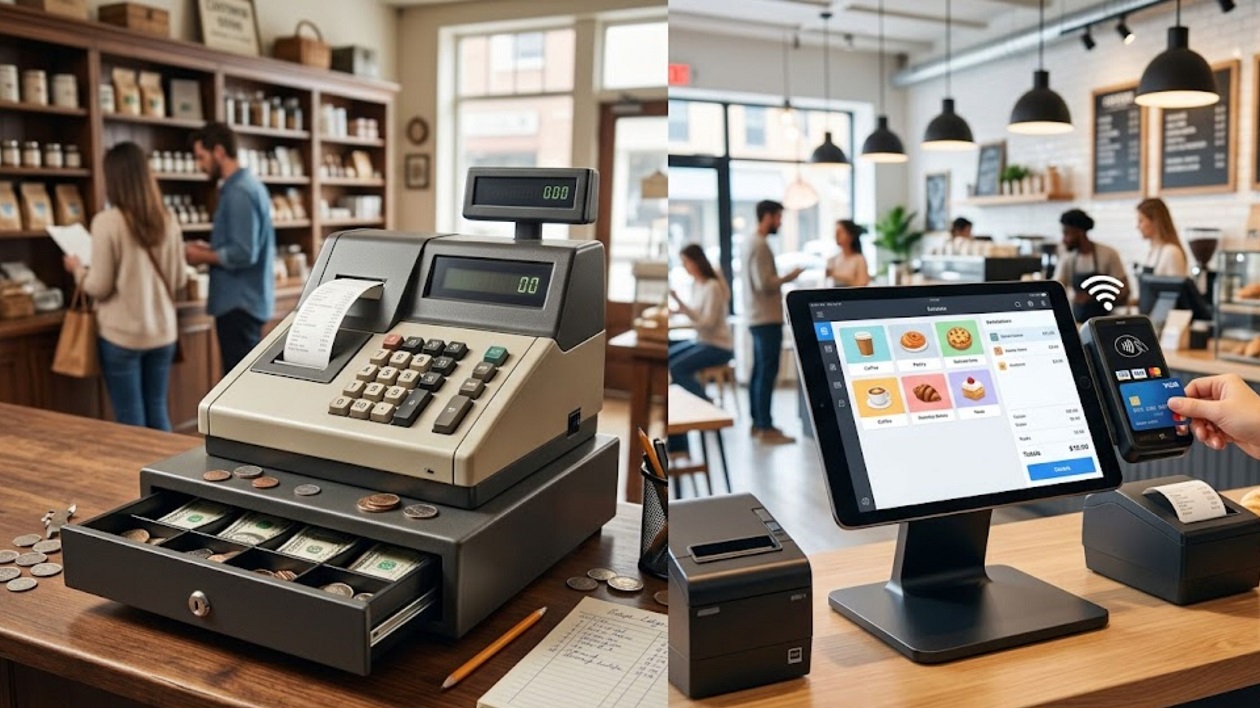
Anyone who has worked behind a counter knows this question comes up sooner or later: what’s the real difference between the tools used to take payments? The difference between cash register and POS system goes far beyond appearance or price. It shapes how you manage sales, track performance, and make decisions every day.
Years ago, things were simple. A basic machine that opened a drawer and printed receipts was enough for most shops. Today, even small businesses rely on smarter systems to avoid errors, keep track of products, and better understand their customers. In more specific industries, owners often look for tailored solutions like a POS system for CBD to deal with compliance and inventory in a more structured way.
Both options still handle payments. But what happens around those payments—that’s where the real difference lies.
What Is a Cash Register?
A cash register is one of the oldest tools in retail, and its purpose has stayed largely the same over time. It’s designed to record transactions and safely store money during the day.
In practical terms, a cash register focuses on a few basic tasks:
- Calculating the total price of selected items
- Opening and securing a cash drawer
- Printing a receipt after each purchase
There’s no deeper system behind it. No syncing with other tools, no automatic tracking, no built-in analytics.
For many small businesses, that simplicity is exactly the point. You don’t need technical skills to operate it, and training new staff takes very little time. It’s reliable, straightforward, and does the job without distractions.
You’ll typically find cash registers in places like:
- Small neighborhood shops
- Temporary retail setups
- Market stands
- Independent bakeries or kiosks
However, once a business starts handling more products or higher volumes, cracks begin to show. Stock has to be checked manually. Reports are limited, often just showing total sales for the day. And when something doesn’t add up, figuring out why can take time.
This is where the discussion around cash register vs POS usually begins. A cash register handles the transaction itself—but it doesn’t help you understand what’s happening beyond that moment.
What Is a POS System? (Breaking Down the Concept)
A POS system, short for Point of Sale, builds on the idea of a cash register but adds a completely different layer of functionality. If you’re trying to understand what is a POS cash register, it helps to think of it as a system rather than a single device.
Instead of one machine, you’re working with a combination of hardware and software designed to manage sales in a more connected way.
A typical POS setup includes:
- A touchscreen device such as a tablet or terminal
- Software that records and organizes transactions
- Payment tools for cards, contactless options, and mobile wallets
- Inventory tracking that updates automatically
- Reporting tools that show performance in real time
This is also where the idea behind POS meaning cashier changes. Many tasks that used to depend on a person are now handled by the system itself—calculations, discounts, stock updates, and even basic reporting.
For example, each time an item is sold, the system instantly adjusts the inventory count. By the end of the day, you don’t just know your total revenue—you can see which products sold the most, which ones didn’t move, and when your busiest hours occurred.
That level of detail changes how decisions are made. Instead of relying on guesswork, you’re working with clear, up-to-date information.
Cash Register vs POS System: Key Differences Explained
At first glance, both systems seem to serve the same purpose—they help you accept payments. But the difference between cash register and POS system becomes obvious once you look at how much control each one gives you over your business.
Here’s a simple comparison:
| Feature | Cash Register | POS System |
| Main purpose | Process transactions | Manage sales and operations |
| Inventory | Manual or not tracked | Automatic and real-time |
| Reporting | Basic totals | Detailed and flexible reports |
| Payment types | Cash and standard cards | Cards, mobile, online payments |
| Integration | Works independently | Connects with other systems |
| Growth potential | Limited | Scales as the business grows |
The contrast in cash register vs POS system isn’t just about features—it’s about how you see your business.
A cash register focuses on individual transactions. A POS system looks at patterns and trends.
With a register, you might know how much you earned today. With a POS system, you can break that number down—by product, by time of day, or even by staff performance. That kind of insight makes it easier to adjust pricing, manage stock, or plan promotions.
That said, not every business needs that level of detail. If operations are simple and steady, a traditional register can still be a practical choice.
In the end, it comes down to one thing: are you only recording sales, or are you trying to understand them and improve how your business runs?
Advantages and Disadvantages of Each System
Choosing between the two isn’t just about features—it’s about how much control and visibility you actually need. The cash register vs POS system debate often comes down to trade-offs: simplicity versus capability.
Let’s look at both sides without the marketing gloss.
Pros of Cash Registers
- Lower upfront cost compared to digital systems
- Extremely easy to use, even for new staff
- Minimal setup, no software installation required
- Works without internet connection
Cons of Cash Registers
- No automatic inventory tracking
- Limited or no reporting beyond daily totals
- Higher risk of human error in pricing or calculations
- No integration with accounting or online sales tools
Cash registers still make sense for very small setups. If you’re running a quiet shop with a handful of products, adding complex software might feel unnecessary.
Pros of POS Systems
- Real-time inventory updates with every sale
- Detailed reports that help spot trends and patterns
- Support for multiple payment types, including mobile and online
- Ability to manage multiple locations from one system
Cons of POS Systems
- Higher initial investment and ongoing subscription costs
- Requires basic training for staff
- Some features depend on internet connectivity
- Occasional software updates or technical issues
When comparing cash register vs POS, the key difference is flexibility. A POS system adapts as your business grows, while a cash register stays exactly the same.
Real-World Insight: What Experts Say
Many business owners hesitate to switch systems until they hear from people who’ve already done it. And in retail tech, the message has been fairly consistent: data matters.
As Harley Finkelstein, President of Shopify, once said in an interview with Forbes, “Retailers who embrace technology to understand their customers will always have an advantage over those who don’t.”
That idea ties directly into the difference between cash register and POS system. A traditional register completes a sale. A POS system helps you understand the customer behind that sale.
In practice, that could mean recognizing repeat buyers, tracking which products drive loyalty, or adjusting pricing based on real demand. These are things a basic register simply can’t do.
Which One Should You Choose?
There’s no universal answer here. The right choice depends on how your business operates today—and where you expect it to go.
Here are a few common scenarios:
- Small local shop with low traffic
A cash register may be enough. It keeps things simple and avoids unnecessary costs. - Growing retail store
A POS system becomes more useful as product lines expand and inventory gets harder to track manually. - Cafes and restaurants
Speed, accuracy, and order management matter. POS systems help reduce mistakes and keep service moving. - Businesses selling both offline and online
This is where POS systems really stand out. They connect in-store and online sales into one system.
When thinking about cash register vs POS system, it helps to ask a practical question: are you solving today’s problems, or preparing for tomorrow’s ones?
Conclusion: Choosing Based on Reality, Not Trends
The difference between cash register and POS system isn’t about old versus new—it’s about function. A cash register does one job well: it processes transactions. For some businesses, that’s all that’s needed.
A POS system, on the other hand, becomes part of how the business runs. It tracks, analyzes, and connects different parts of daily operations. That added complexity can feel unnecessary at first—but it often pays off as the business grows.
In the end, the best choice is the one that matches your actual workload, not just industry trends. Some businesses benefit from keeping things simple. Others need tools that give them a clearer picture of what’s happening behind the counter.
FAQ
1. What is the main difference between cash register and POS system?
A cash register is built for one job—taking payments and storing money during the day. A POS system goes further. It keeps track of what you sell, records data automatically, and gives you a clearer picture of how your business is performing over time.
2. Can a POS system replace a traditional cash register completely?
In most situations, yes. A POS system can handle everything a regular register does, but also adds tools for tracking sales, managing stock, and reviewing performance. That’s why many businesses eventually move away from standalone registers.
3. Is a POS system worth it for a small business?
It really depends on how the business operates. If sales are simple and there aren’t many products, a cash register might be enough. But if you need better visibility into stock, sales patterns, or customer behavior, a POS system quickly proves its value.
4. What does POS meaning cashier actually refer to?
In the past, the cashier was the person responsible for handling payments and recording sales. With modern systems, much of that work is done automatically. The POS system calculates totals, logs transactions, and reduces the need for manual input.
5. Are POS systems secure for handling payments?
Most modern POS systems are built with security in mind. They use encrypted connections and follow industry standards to protect payment information. Still, security also depends on how the system is set up and maintained, including regular updates.
6. What is a POS cash register and how is it different from a regular one?
A POS cash register is more than just a payment device. It combines software and hardware to handle sales, track inventory, and store useful data. A traditional register only records transactions, while a POS system helps you understand them.