

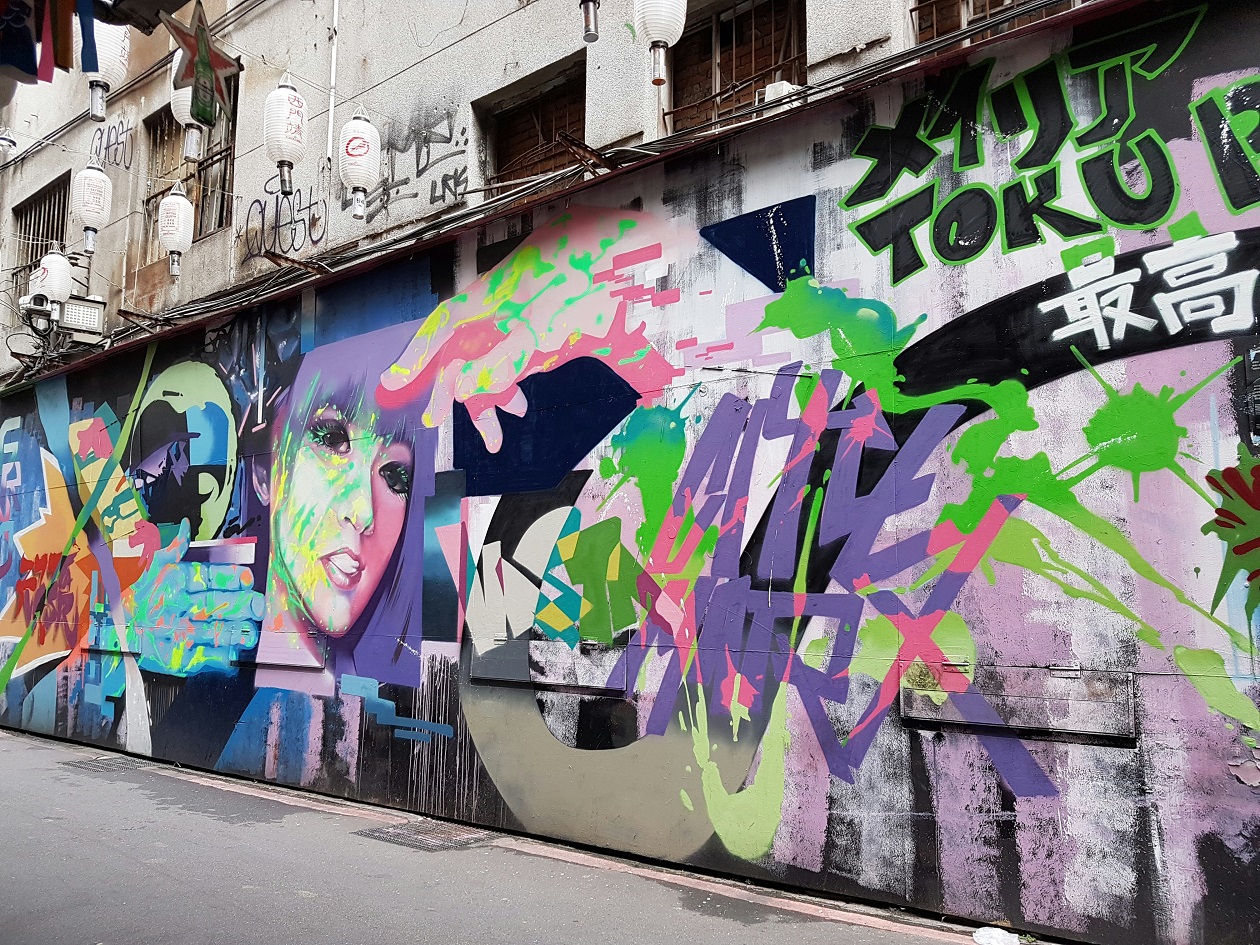
If you are studying with an online Chinese teacher or using a platform to learn Mandarin online, the visual culture of Chinese cities will be one of your first encounters with the gap between official representation and lived urban reality. In major cities, all Chinese streets are very much a complex visual experience. Also, some Chinese language schools, which include GoEast Mandarin in Shanghai, may present and analyze contemporary urban culture as part of their larger cultural studies program.
At the start the difference is seen between what is and what is not public art, which in China is of much greater import than in most Western urban settings. Sanctioned public art murals that are commissioned by the municipal governments, art installations in what are designated creative zones, and large-scale decorative paintings on approved surfaces are very much a feature of Chinese cities’ public spaces, which also plays out a long history of using public visual space for political and cultural communication.
However, in a different plane, there is the issue of unsanctioned street art. In China, there is no set legal structure that supports street art as a form of expression, and thus unauthorized painting of public and private structures is classified as a case of damage that is against the law regardless of the art’s value. Also, as a result, artists who choose to work in nonofficial spaces do so at a risk, with their work removed and they themselves open to legal action. This lack of support creates a large gap between what is approved creative output and what is independent expression, which in turn puts forward the development of street art as a very limited forum, while at the same time it is seen to play out as a form of what almost is a subversive element in the urban setting.
Beijing’s 798 Art District and Shanghai’s M50 and Moganshan Road have become the primary platforms for international audiences to see present-day Chinese visual art in an urban setting, which in fact are more institutionalized art and design parks than what is thought of as traditional street art. Both of these grew out of former industrial areas, which they have re-purposed for galleries and studios, and are now very much a part of the cultural tourism in their cities. What does exist in terms of street art within and at the edges of these districts is with a certain degree of tacit tolerance, which doesn’t extend to other urban areas, which in turn creates a defined space for creative expression, which all players in the game know the rules to.
Outside of what is put forth by official channels is street art in Chinese cities, which does put out its word in the ignored and in-between spaces that are a result of rapid urban change. These are the transient surfaces of a city in flux: walls of buildings that are to be torn down; construction hoardings that line ever-expanding development; and the shadowed areas under railway bridges or within underpasses that do not receive consistent municipal care. In these marginal settings artists are able to work with a great deal of freedom, which is hard to come by elsewhere; they use the city’s constant change as both canvas and inspiration. Among China’s major urban centers, Chengdu has stood out to develop a distinct tolerance for street art, in particular within neighborhoods like Yulin and Shazikou. Here a very alive mix of independent cafes, bars, and creative businesses has built a community that supports art and experiment. This cultural system not only puts forth physical space for visual art to grow but also cultivates acceptance and curiosity among residents and visitors, which allows street art to be more than just decoration but instead to be a live conversation between artists and the urban landscape.
In China the relationship between street art and digital platforms is very much a unique story that doesn’t play out the same way in the West. It is observed that in China street art is very short-lived, which in turn means that the main audience for the art is often the social media user who comes across documented pieces on Xiaohongshu, Weibo, or Douyin.