



Colocation is often perceived as a clear and predictable infrastructure model. A company places its own equipment in a colocation server environment within a data center, pays for rack space and power, and receives a controlled environment for running critical systems. At the expectation level, the model appears simple and logical.
This perception is reinforced by the way data centers structure their initial commercial offers. Pricing per rack or per kilowatt is presented as the main reference point, creating a sense of transparency and ease of comparison between different facilities.
The problem is that colocation is not the rental of physical space. It is a model based on reserving data center resources for a specific customer. The price includes not only actual usage, but also the continuous readiness of the infrastructure to deliver the agreed parameters.
As a result, two offers with the same “price per rack” may include fundamentally different conditions. Most often, the differences relate to:
- power limits and usage rules;
- network capabilities and connection costs;
- operational support and SLA terms;
- contractual restrictions and scaling rules.
Without taking these factors into account, price comparison loses its meaning.
What the base colocation price consists of
When a data center prepares a commercial offer, it is based on the minimum set of resources required to host equipment and ensure its stable operation. This set is what is typically reflected in the base price shown in the initial calculation.
As a rule, the base colocation price includes:
- placement of equipment in a rack or a dedicated part of a rack;
- a pre-agreed power capacity limit;
- cooling within standard parameters;
- physical security and access control;
- regulated access for the customer’s personnel.
At this level, offers from different data centers may indeed look comparable. However, the base price describes only the initial configuration and almost never reflects the actual operating budget.
What remains outside the initial price
Most colocation costs are associated not with placement itself, but with ongoing infrastructure operation. These expenses are rarely hidden intentionally, but are often moved to separate sections of the contract or technical appendices.
Most commonly, network connections, additional cross-connects, remote hands services, power expansion, configuration changes, and higher SLA levels are billed separately. These items account for the main difference between the nominal price and the actual cost of colocation.
Why is the initial price not equal to TCO
The base price shows the cost of “entering” a data center, but it does not answer the question of how much the infrastructure will cost one or two years later. As workloads grow, new connections appear, power consumption increases, network architecture becomes more complex, and the need for operational support rises.
If these factors are not considered when selecting a facility, the final budget almost always exceeds initial expectations. This is why a correct colocation assessment starts not with rack pricing, but with an understanding of the infrastructure usage scenario over several years.
Power and energy model
Power availability is the main driver of colocation costs. Available capacity defines the data center’s architecture and accounts for a significant share of its expenses. For the customer, this means that the final price depends not so much on the number of racks, but on how much power the infrastructure requires and under what conditions it is reserved.
Reserved power vs actual consumption
In colocation, customers primarily pay for reserved power. The data center allocates a power capacity limit to the customer and is required to ensure its availability at all times. Even if equipment temporarily consumes less power, the cost does not decrease, as the capacity is already reserved. This approach makes the model predictable, but requires accurate load planning before deployment.
Price per kW and its conditions
Pricing per kilowatt is considered the most transparent model. However, the kW rate alone has no meaning without the conditions attached to it. Calculations always include committed load parameters, allowable peaks, and overage rules. Depending on the data center, short-term exceedance of limits may be allowed or may result in financial and technical consequences. These details are what determine the actual cost of power consumption.
Density and tariff impact
The higher the equipment density within a rack, the greater the demands on the engineering infrastructure. High-density configurations increase the load on power and cooling systems, which is inevitably reflected in higher tariffs. A common mistake is relying on average kW pricing without considering that dense racks are subject to separate conditions and limitations.
Energy efficiency and long-term cost
The PUE metric rarely appears in commercial offers, but it directly affects tariff stability. More energy-efficient data centers are usually more expensive at the entry stage, but they handle load growth better and revise pricing less frequently.
Errors in power planning are difficult and costly to fix after deployment. Increasing capacity requires changes to the engineering infrastructure and rarely happens quickly. For this reason, power consumption calculation is a critical element in assessing colocation costs.
Space formats and their impact on pricing
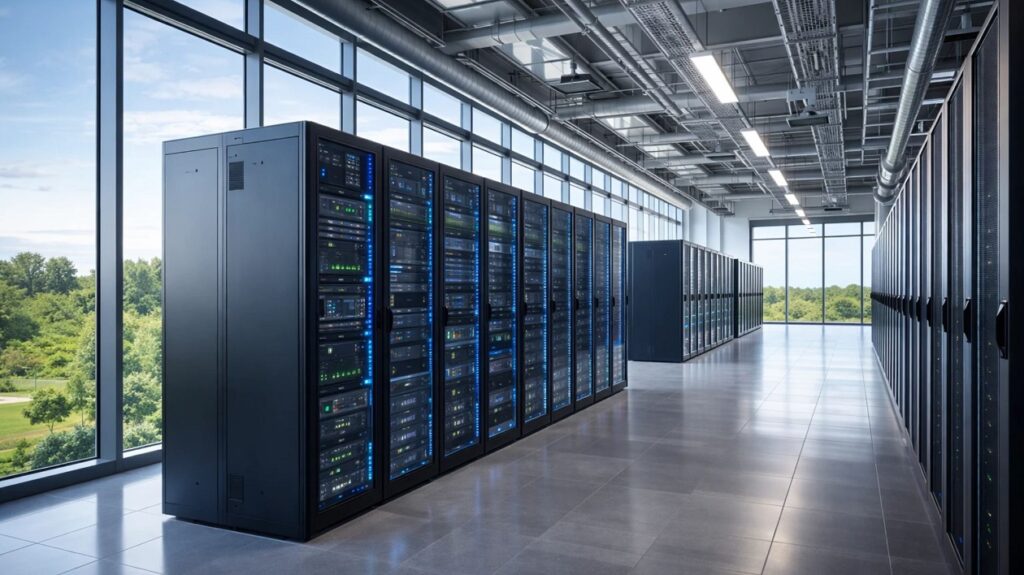
Rack-based placement remains the most common colocation option. This format provides a clear cost structure and is suitable for most infrastructures with predictable workloads. Partial rack placement lowers the entry threshold, but almost always increases the cost per resource unit, as it limits density and scaling options.
A full rack is considered the most balanced option. It provides greater control over equipment layout, power distribution, and future infrastructure growth without imposing strict contractual limitations.
Cage and physical isolation
A cage is a dedicated area within a data center, physically separated from other customers. This format is chosen by organizations that require controlled access and the ability to scale infrastructure within a single, isolated space.
From a cost perspective, a cage is not always more expensive than a set of individual racks. With stable consumption and sufficient equipment volume, it can be economically justified, as it allows more efficient use of power and cooling. However, minimum size requirements and contract term commitments make this format less flexible at the initial stage.
Private suite and customized conditions
A private suite is a fully dedicated room within a data center. It is used in projects with elevated requirements for security, control, and isolation. Pricing for this format is calculated individually and includes not only space and power, but also separate engineering and operational conditions.
This option has a high entry threshold, but provides maximum predictability and control over the long term.
Data center location and resiliency level
The location of a data center has a direct impact on colocation costs even when technical parameters are identical. Pricing is shaped not only by the cost of land and electricity, but also by the region’s network role, infrastructure density, and regulatory requirements.
Major urban hubs and traffic concentration points are almost always more expensive. They provide better connectivity and a wider choice of carriers, but this infrastructure comes with a high cost base. Regional facilities, by contrast, often offer lower pricing with a comparable level of reliability.
Europe, the United Kingdom, and the United States: pricing logic
In Europe, colocation pricing varies significantly by region. Western and Northern Europe are traditionally more expensive due to high energy efficiency standards and regulatory burden. Eastern Europe often offers a lower entry threshold while maintaining a modern level of engineering infrastructure.
In the United Kingdom, the key factor is the concentration of data centers in the London area. London facilities provide excellent connectivity, but have higher colocation and network connection costs compared to secondary locations.
The U.S. market is more fragmented. Major hubs offer a wide choice of providers and pricing models, while regional markets are cheaper but have a lower level of network diversity.
Resiliency level and its real value
Data center classification by resiliency levels is used as a guideline, but does not always reflect practical value for businesses. Higher resiliency levels increase costs due to more complex engineering systems and maintenance requirements.
At the same time, the actual difference in availability between adjacent levels is often smaller than expected. For most commercial scenarios, a level that ensures stable operation and allows planned maintenance without system downtime is sufficient.
Network, cross-connects, and network costs
When selecting a data center, attention is usually focused on colocation space and power pricing. The network component is often treated as secondary, especially if basic connectivity is formally included in the offer. In practice, however, networking frequently becomes one of the most expensive budget items.
The reason is that colocation involves integrating the customer’s infrastructure into the data center’s network ecosystem, not merely placing equipment in a facility.
Cross-connect as a separate cost item
A cross-connect is a physical or logical connection between the customer’s equipment and a carrier, cloud platform, or another infrastructure participant. Such connections are almost always billed separately.
Typically, pricing consists of a one-time setup fee and a recurring monthly charge. The more complex the architecture and the higher the redundancy requirements, the greater the number of cross-connects and the higher the total cost.
Meet-me room and access to network infrastructure
In most large data centers, interaction with carriers is handled through a meet-me room. Access to this infrastructure is part of the data center’s pricing model and is rarely free of charge.
Even when the physical connection appears simple, pricing includes operation of the network infrastructure, connection management, and resiliency support. These costs often become apparent only after deployment.
Carrier diversity and budget growth
One of the advantages of colocation is the ability to connect to multiple carriers. However, each additional carrier means separate connections, additional charges, and increased network management complexity. Without a clear understanding of failure scenarios and actual redundancy requirements, network costs can quickly exceed expectations and offset the cost advantages of colocation.
When networking becomes a critical factor
Network expenses are especially noticeable in distributed infrastructures, hybrid scenarios, and projects with strict latency requirements. In such cases, network costs may equal or even exceed the cost of equipment placement. Accurate evaluation of network costs must start with architecture and usage scenarios, not with a data center price list.
Common colocation pricing models
Per-rack pricing remains one of the most straightforward models. The customer pays a fixed fee for a rack with predefined limits on power and cooling. This approach is convenient for infrastructures with predictable workloads and a stable equipment footprint.
The limitation of this model lies in its lack of flexibility. As density increases or the power profile changes, pricing quickly becomes suboptimal, and upgrades require renegotiation of terms.
Per-kW pricing
Per-kilowatt pricing is consumption-oriented and more commonly used in modern data centers. It is better suited for high-density configurations and allows pricing to be more closely aligned with actual load.
At the same time, this model requires careful review of committed load and overage conditions. Without this, the per-kW rate may appear attractive at the start but become unfavorable as the infrastructure grows.
Cage and private suite pricing
For large deployments, pricing models based on dedicated areas or rooms are used. In these cases, pricing is calculated individually and includes space, power, security, and operational conditions. Such models require long-term contracts but provide maximum predictability and control at scale.
Hybrid and custom models
In practice, combined pricing schemes that blend space- and power-based charges are common. They allow offers to be tailored to a specific architecture, but make comparisons between data centers more complex. A custom price does not always mean better conditions. Without a transparent cost structure, such offers are harder to analyze and plan over the long term.
How to read a colocation quote correctly

A colocation quote rarely provides the full picture on the first page. Key parameters are usually spread across the main pricing sheet, technical appendices, and SLA terms. For this reason, analysis should start not with the final amount, but with the resources and obligations behind it.
First of all, it is important to understand which power limits are fixed, what conditions apply when those limits are exceeded, and what is included in the base price versus what is offered as optional add-ons.
Lines that should not be overlooked
When comparing colocation offers, it is critical to pay attention to the following elements:
- committed load terms and power overage rules;
- cross-connect and network infrastructure pricing models;
- included and billable remote hands hours;
- conditions for power and space upgrades;
- contract duration and early termination terms.
These points are most often the source of discrepancies between expected and actual costs.
Colocation and alternatives from a cost perspective
An on-premise data center may initially appear more cost-effective, especially if the hardware has already been purchased. However, when evaluated over the long term, on-premise infrastructure almost always loses to colocation in terms of total cost. Capital expenditures, maintenance of engineering systems, and power and cooling redundancy fall entirely on the company.
Colocation allows a significant portion of these costs to be shifted to operating expenses while providing access to data center–scale infrastructure without the need to build and maintain it independently.
Colocation and cloud
Compared to cloud platforms, colocation is more cost-effective in scenarios with stable and predictable workloads. Costs do not depend on sudden usage spikes and do not grow linearly with increases in data volume or traffic.
Cloud solutions remain more flexible for variable and experimental workloads, but with long-term use and high utilization, their cost often exceeds colocation budgets. This is why many companies adopt hybrid models that combine colocation and cloud.
When colocation is economically justified
Colocation is most justified in the following scenarios:
- stable workloads and a long planning horizon;
- requirements for control over hardware and architecture;
- the need for predictable infrastructure costs;
- use of hybrid and distributed solutions.
In projects with highly variable workloads or short-term objectives, alternative models may be more suitable.