

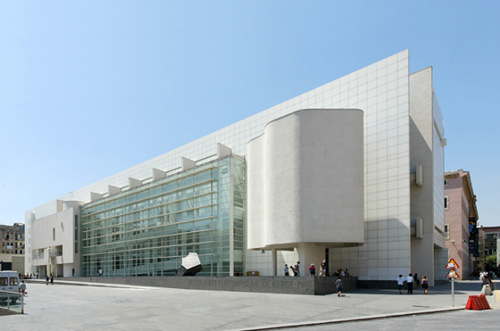
Another Relationality, a series of conferences and workshops on institutional critique and the political role of art, was held in the Museum of Contemporary Art, Barcelona (MACBA) in March 2006, broadly regarded as a progressive art institution. The event involved the critical approach of creativity, precarity and knowledge in the context of contemporary capitalism, and included thinkers like Maurizio Lazzarato, Brian Holmes, and Antonella Corsani. However, the hypocrisy inherent in this desire came out in a very graphic form when local activist group Ctrl-I officially pulled out of the involvement.
It was not a typical anti-institutional outside gesture by Ctrl-i. The group included some former temporary workers at MACBA itself. Their now-renowned phrase that it is more precise to discuss precariousness at MACBA than to give a nutrition lecture in the McDonald’s restaurant went to the root of the matter. The organisation that purported to criticise neoliberal precarity was more mired in precarious labour practices. Withdrawal, ctrl-i turned criticism into action, demonstrating how institutional self-reflexivity tends to obscure the continued exploitation.
This episode is an example of a larger phenomenon, the neoliberalization of cultural and educational institutions. The outcome of neoliberalism is to encourage individual entrepreneurial liberty and at the same time, deconstruct social protective mechanisms, as geographer David Harvey has argued. This creative destruction does not spare culture and education. State-funded organisations are becoming more and more market players, concerned with efficiency, branding, collaboration, and revenue production and outsourcing labour and staff, normalising insecurity.
In this set-up, cultural institutions are experiencing a legitimacy crisis. There are those who
openly welcome commercialisation and others who use the tongue of criticism, participation, and social responsibility. The European Cultural Policies 2015 initiative, backed by organisations like Iaspis and the European Institute of Progressive Cultural Policies (eipcp) is one of the attempts to picture a more ethical or progressive future of publicly funded art. However, these projects tend to avoid issues of class power, wage relations and internal labour inequalities, referring to models of governance and transnational networks.
We then have a progressive neoliberalism in which institutions both admit critique and internalise it. The resistance is not shunned but dealt with. Activist practices are welcomed in, contextualised, enabled and eventually enclosed. Even though they are represented as spaces of dissent, institutions are recreating the same environment of outsourcing, temporary work, and unpaid internships that protesters oppose. Critique is internalized within the institution’s cultural capital.
MACBA is a sign of this tension. It is also supported financially through the corporate sponsors and consultancy organizations, which represent the force of neoliberalism during the radical debates and activist workshops. Its code is more prone to anticipate precarity and opposition, though its workers experience all the instances of attack. The institution specifies the critique and determines the circumstances under which the critique ought to be carried out.
The question in this case is not whether cultural institutions can talk about neoliberalism, but whether they can do it in some practical sense, more than that. Unless critique has led to changes in the labour relations, the form of decision-making or allocation of resources, it can turn out to be a performance-infinite loop of institutions analysing themselves and going about business as usual.
The act of declining Ctrl-i to another variant of institutional criticism, which is founded on lived material conditions and does not consist of the act of symbolic gesture. It is a reminder that any cultural organization that is really progressive must confront the fact that it has its own role in the continuation of inequality. The absence of clear antagonisms and responsibility amplifies the human face of neoliberalism by the progressive institutions, not its opponents.