

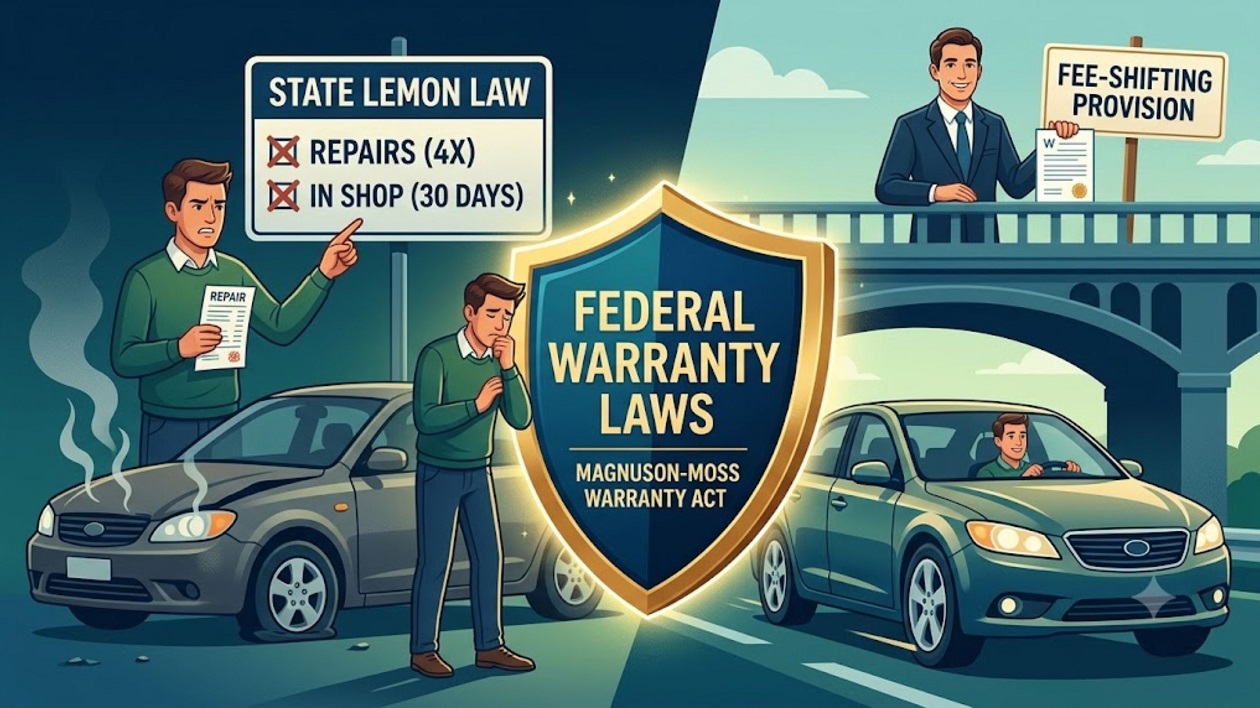
Many car shoppers believe that the state lemon law has their back if they end up with a lemon. In a few cases, that may be true. In reality, state lemon laws are more limited than consumers assume. Many buyers of defective cars do not meet the standards required under their state’s lemon law. For those, there is a federal law that is specially designed to protect consumers in this situation, the Magnuson-Moss Warranty Act.
What State Lemon Laws Actually Cover
State lemon laws have very strict conditions. Typically, you need to take your vehicle to the repair shop for the same issue at least four times, or the vehicle needs to be in the shop for 30 days or more during the first 12 to 24 months after purchase (or lease) while under warranty. If your vehicle qualifies under the state lemon law, you are entitled to a refund, which includes the cash price you paid, and fees, to pay off your loan, minus a reasonable allowance for use.
How Federal Law Picks up Where State Law Stops
The Magnuson-Moss Warranty Act was passed in 1975 and is overseen by the Federal Trade Commission. It covers any consumer product that is sold with a written warranty, and that includes vehicles. So if you bought a used car that was covered by an active manufacturer’s warranty or dealer warranty when you bought it, the federal government is here to help.
Here’s the part that most folks overlook. If you bought a used car and it’s still under the original factory warranty, the manufacturer can’t just wash its hands of that warranty because a new person is holding the warranty. Working with a lemon law attorney in Texas can help you understand how the original manufacturer’s warranty still applies, which you could argue is a form of warranty coverage at the time of sale. So you’re entitled to coverage under the written warranty.
The same is true of implied warranties under Magnuson-Moss. If the manufacturer provided any written warranty at all or sold a service contract on the vehicle within 90 days’ time, too bad, they can’t disclaim the implied warranty of merchantability. By giving you a warranty, they already promised the vehicle was fit for basic transportation.
The federal standard also has a more consumer-friendly test than the majority of state laws. Instead of being forced to prove exactly four repair attempts within 18 months or 30 days off the road within the first 12, the question is just whether the manufacturer had a “reasonable number of attempts” to fix the vehicle with the defect. That’s a different, and in many cases, lower, bar to clear.
The Fee-Shifting Provision Changes the Math
A cost-related reason why customers often do not seek warranty claims is that the prospect of taking on a corporate legal team feels too expensive.
Federal law acknowledges this, too. The Magnuson-Moss fee-shifting provision states that if you prevail in a warranty lawsuit, the manufacturer must pay your attorney fees. In other words, you can hire a lawyer without having to pay him or her up front, because the company will be on the hook for those costs if you win. That provision has the effect of making a lot more consumers eligible for a fair fight.
It also means that companies are more likely to come up with a fair settlement, quickly, if they understand that a successful claim likely means they’ll get the bill for the customer’s lawyer, too.
What the FTC Says About Warranty Voiding
Another important protection to consider: The Federal Trade Commission reports that it’s illegal under the Magnuson-Moss Warranty Act for manufacturers to deny warranty coverage because someone opted for an aftermarket part or used an independent repair shop instead of a franchised dealer. They can’t just deny coverage if they think a cheaper part or mechanic didn’t get the job done and caused a problem.
Records Are Everything
Federal warranty claims are not based on trust but on written records. You must keep track of each repair or attempted repair: the date, the problem you reported, what they checked or replaced, and the amount of time your vehicle could not be used must be recorded. Those are the days out of service, and they are the most important part of a Magnuson-Moss claim.
You must keep every repair receipt, note every phone call. If the service manager tells you that the part is on backorder and the car will be tied up for another two weeks, make a note of it. Diminished value, what your vehicle would be worth less if you sold it, given its defects and repairs, is a harm under federal warranty law, but once again, you need to prove it.
Choosing the Right Legal Pathway
The interesting thing is that state and federal claims aren’t mutually exclusive. Many buyers have options under both, and the right move depends on exactly where a vehicle and its repair history fall.
State rules vary in ways that matter enormously. Texas, for example, uses a strict four-times test for repair attempts with specific mileage and timeframe conditions. An experienced attorney is the most effective resource for determining whether a state claim still applies, or whether the broader protections of federal law are the stronger route.
If your state law won’t help you, that doesn’t mean the manufacturer walks free. Federal warranty protection was designed specifically to close that gap, and it’s more accessible than most buyers realize.